Wildfire Mitigation 101: Protecting Your Land with Outlaw Forestry with Mirr Ranch Group
Welcome back to the Land Bulletin podcast, where every other week we bring you experts in the field to impart their knowledge when it comes to the ranch and sporting property market, buying and selling advice, the latest, best stewardship practices, as well as topics that impact landowners every day. I'm your host, Haley Mirr. Let's jump in. Welcome back to the Land Bulletin podcast. It's Haley Mirr here, and today we are going to be going over something that is incredibly important for landowners. If you're a seller, if you're a buyer, it doesn't matter, wildfire mitigation and land management and how those go hand in hand with whatever you're buying. And today, helping us out go deeper into what you should be looking out for is the owner of Outlaw forestry. Bryce Gidney, welcome to the show. Bryce. How are you today?
Bryce Gidney (00:53):
Good. Thanks for having me.
Haley Mirr (00:55):
Thanks for being on. Is this a prime time of year to start mitigating for next year? Are you busy right now?
Bryce Gidney (01:03):
Yeah, absolutely. I'm slammed. I could be working seven days a week, but right now just five but long days trying to get everything done before the snow flies.
Haley Mirr (01:14):
Yeah, I'm sure. And where are you calling in from?
Bryce Gidney (01:17):
I'm calling in from gypsum, Colorado, so just west of Vail.
Haley Mirr (01:21):
Awesome. Can you tell us a little bit about how the company started and what inspired your approach to this type of land management?
Bryce Gidney (01:30):
Yeah, absolutely. I was an arborist for over 10 years doing residential tree work and just kind of got burnt out from that, tried my hat with construction for a little bit and was not a good fit for me and just wanted to start a business doing what I loved, which was being in the woods and combining wildfire mitigation, hunting, snowmobiling, all of the things into one business that,
Haley Mirr (02:03):
Yeah, it's something you love, it's something you understand and it's something that it's important. So it has all those columns.
Bryce Gidney (02:09):
Yeah, something I'm super passionate about.
Haley Mirr (02:11):
So in looking at your business, there's a phrase that you use doing things right the first time. What does that mean in the context of land and forestry work?
Bryce Gidney (02:20):
So for me, I like to go above and beyond from the very beginning, from the walkthrough all the way through to the final, finishing a project, but each step I like to take and just go above and beyond. So the whole project is perfect. My attention to detail is very high, and so when I finish a property, I want it to be perfect and I wanted something that the landowner's proud of and that I'm proud of.
Haley Mirr (02:49):
Yeah, it feels like if it's not perfect, I could go awry pretty fast, so might as well do it perfect the first time and not have to deal with that. I think it's great that you have this arborist background. I don't see that all the time with some of this forest fire mitigation work. How do you balance that technical expertise as an arborist? What's the bigger picture of what landowners are needing? At one point? As land managers
Bryce Gidney (03:17):
As an arborist, I'm able to see the trees in which trees are healthy, diseased and be able to focus more on taking out diseased trees and keeping the live healthy stance and allowing that evolution to continue while still doing fire mitigation and what's going to be the best for the wildlife, the water on the property and everything like that.
Haley Mirr (03:44):
So it seems like instead of just kind of taking out massive reams of forest or the typical kind of forest fire mitigation, just take out more trees, you're really looking at the health and sustained wellbeing of the habitat that you're working in.
Bryce Gidney (04:01):
Yeah, absolutely. So my whole background is hunting and I take wildlife, the deer, the elk, every other critter that's on that property into account and what's going to be most beneficial for the animals and the land versus just going in and because get fire mitigation, but you have to also take care of the animals and the stuff they call at home.
Haley Mirr (04:28):
In your opinion then, what does effective wildfire mitigation actually look like when taking all those variables into account on a larger ranch, something of bigger scale like that?
Bryce Gidney (04:40):
So for me, it looks like a national park when I'm done like Central Park in New York, a very beautiful overstory with healthy mature trees as well as younger saplings that are still coming up. And then removing deadfall and overgrowth of brush that is growing up underneath and removing those ladder fuels. And so opening up these beautiful forests that have just been overgrown for hundreds of years because they haven't burned.
Haley Mirr (05:13):
I'm guessing you probably hear some kind of misconceptions when talking to landowners. Are there a few kind of bigger ones that people tend to think and you're like, this isn't really what goes into effective wildfire mitigation?
Bryce Gidney (05:25):
A lot of people think you're just clear cutting the land and just taking out all the trees and all the brush that no plants are really good. Everything's like a fire hazard, but it's selectively taking out individual plants from a forest and leaving other ones that are going to be beneficial. You want the habitat for the wildlife and you want to just create spacing in the forest.
Haley Mirr (05:50):
Yeah, that's huge. I think that's what a lot of people I work with think of is just the kind of the clearing, but sustained wildlife habitat I think is huge and people don't understand that.
Bryce Gidney (06:01):
So in an example of clearing strategic fuel breaks are amazing. And so that is going in and clearing on a property I'm working on currently today we are going up a road and clearing out 20 to 40 feet, 50 feet on each side. And so it looks like you're clearing out a little bit on the sides and then opening up the forest beyond that.
Haley Mirr (06:32):
So what goes into deciding in that scenario what to clear and what not to clear? Is it fuel safety from roads? What goes into that mindset?
Bryce Gidney (06:44):
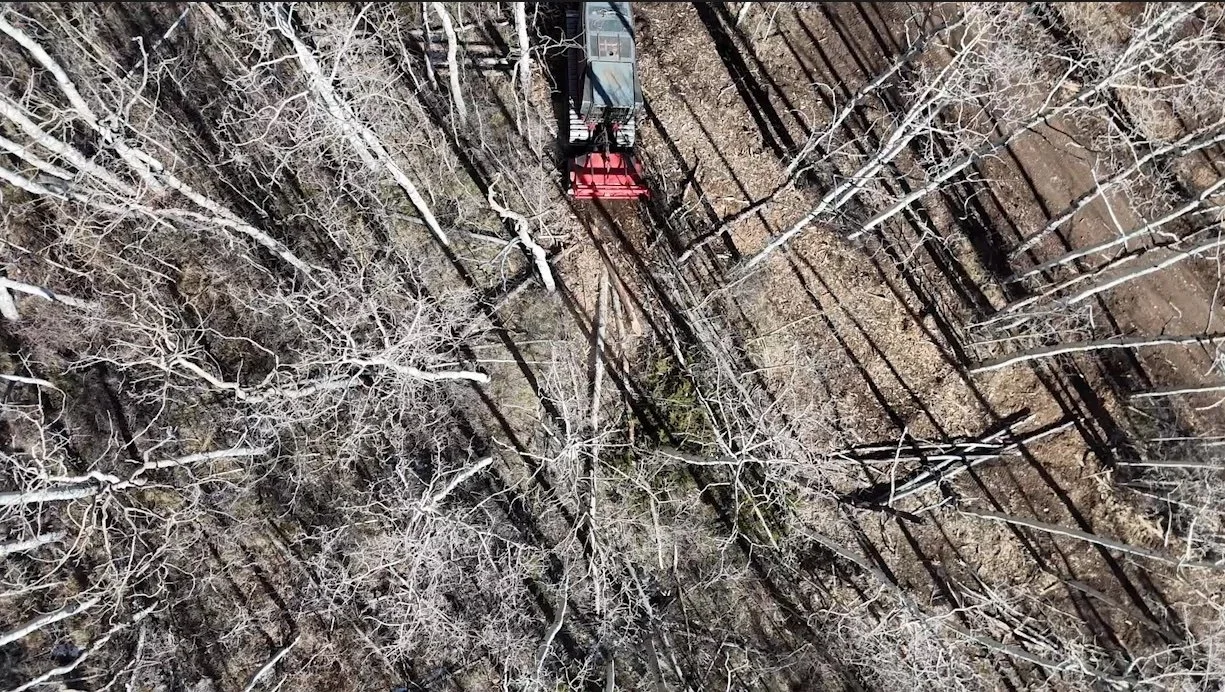
For me, I like to, I'm taking out anything that's dead and then I'm doing two passes on either side of the road of everything, and so I'm getting 10 to 20 feet on either side of the road with nothing in it unless there's some really beneficial trees that are there, some big mature and I'm going to aspens. So those will stay, but everything else goes and then that creates a fuel break that allows firefighters to be able to fight the fire along that road.
Haley Mirr (07:14):
So that's more for helping with that piece with the firefighters being able to access more of the property.
Bryce Gidney (07:19):
Yep, exactly. And so it's aesthetic for this landowner because it was completely overgrown. I couldn't drive my truck up this road without getting it all scratched up and there was deadfall everywhere. So I hit the aesthetic part as well as creating this fuel break that is going to be beneficial for the wildland firefighters.
Haley Mirr (07:44):
So you kind of hit on something just now and some listening understand the benefits of certain types of trees when it comes to forest fire, but you mentioned that aspens, for instance, are a beneficial tree to have on your property when trying to mitigate against forest fires. Can you just tell our listeners, this can be a little snippet about which trees are beneficial. I know a lot are not as beneficial, but what are the keystone aspen that help
Bryce Gidney (08:13):
Aspen are amazing. There's a lot of Douglas fur and blue spruce on the property. Those are great pinon pines and ponderosa pines, really amazing trees and really beneficial to the ecosystem.
Haley Mirr (08:29):
Got it. I did a thesis on beetle kill and those were all lodgepole. So those are kind of the quintessential ones that when we see these massive fires breakout, that's kind of the main fuel source.
Bryce Gidney (08:44):
And lodgepoles are also an amazing forest if you can control the beetle and take out the deadwood that's in there. And a lot of times what happens with the beetle kill is there's so much downfall and deadfall inside the forest that it's just a ticking time bomb.
Haley Mirr (09:02):
And that's kind of what we're seeing in some of these bigger fires in Colorado. Can you walk us through your process when you first visit a property, what are you looking for? How are you mapping it out? What are you looking to take out? Can you tell us a little bit more about that?
Bryce Gidney (09:17):
Yeah, absolutely. My process starts first and foremost with getting to know the client, the landowner and just connecting with them personally. And then from there I try to figure out what their vision for the property is, what their goals are, what they'd like to see the property look like when they're done, and kind of just start to visualize what their overall vision is going to be when this whole project's complete down the road.
(09:49):
and I like to look at is this a property you're going to hand down for generations? It's very important to think long-term. And so trying to help the client see what's a long-term vision is for their property. From there, I like to do a site walk or drive on some of these larger ranches. It's hopping in a side by side and driving the ranch up and down the roads and looking to see different areas. And then a lot of people will have different priorities and so usually the customer or the landowner will give me their priorities, I want to start here and then this is kind of my last priority and finish here.
Haley Mirr (10:35):
Got it.
Bryce Gidney (10:36):
And so trying to mentalize that and think about the plan as I see their priorities, I kind of discuss with them the fuel load that's in each area and start to help them visualize what my services can do and what I can do to mitigate the risk and enhance the forest, enhance the wildlife habitat and just see if that aligns with their vision and go back and forth to come up with the best plan. Another thing that I do is I fly a drone over the property and kind of get before footage of different zones and I can tell where wildlife game trails are and good forest with heavy understory and stuff like that.
Haley Mirr (11:22):
I would love to know too. So are you primarily helping land managers and landowners with their properties just as a running thing or you looking holistically too at insurance? Are landowners calling you and being like, Hey, I didn't qualify for property insurance. I need to do X, y and Z. Can you help me qualify? Is that something you've experienced as a ranch manager?
Bryce Gidney (11:51):
Yeah, absolutely. Insurance is a huge thing for a lot of these ranch owners and landowners and either regaining insurance or when you purchase a property getting insurance for the first time. A lot of these insurance companies require fire mitigation to be completed on their property and it also helps for better rates. So a lot of times clients will reach out to me, I will do fire mitigation on their property and do the before and after footage with the drone and that'll allow them to submit to their insurance companies to either get re-certified or get a better rate because they've done a bunch of fire mitigation and made their property safer.
Haley Mirr (12:37):
That's awesome. Are you seeing that more and more? I feel like a lot of our landowners are unable to get new insurance or qualify when they're purchasing, so this would be an incredible tool. Are you seeing more and more inquiries like that?
Bryce Gidney (12:50):
Yeah, I'm seeing a ton of inquiries about that. I know a lot of people will reach out and no insurance company will touch them because they live in Colorado and then how long and big our fire seasons are and they're just going up every year. So a lot of insurance companies just, I won't touch you until you do something.
Haley Mirr (13:12):
Well, it's good to know that there is a solution to that instead of just walking away and not being able to do it because experienced some of that. So don't always feel like there's no solution. There's a way to kind of manage some of that. How should range managers approach land management holistically? What do they need to consider?
Bryce Gidney (13:31):
I would say they need to consider the long-term goal, the legacy property. What do you want your ranch to look like for your grandchildren and great-grandchildren? Start slow and come up with a plan that you can do yearly to achieve the bigger goal and not just think of it as I need to get this done in order to protect myself. You will protect yourself immediately by starting fire mitigation, but you also got to think long-term for the health of the land and being a steward of your land because it's just going to keep getting passed down for generation and generation and a lot of land that I see hasn't been touched for hundreds of years and it's completely overgrown and people don't have access to their land anymore. You have 2000 acres ranch, but the amount of land that you can actually access is 10% of that because it's so overgrown.
Haley Mirr (14:29):
We had a property out east where we couldn't even drive a side by side and it wasn't even trees, it was sunflowers and weeds and all this underbrush that was just so difficult. We ended up, I think hiring a goat herder to help with some of that. It was just so crazy. But you have these thousands and thousands of acres and you think you have access to all these things, but if you don't, and what you were saying earlier with forest fire firefighters coming through and having to access things too, if you can't access parts of the ranch then it doesn't make a lot of sense.
Bryce Gidney (15:08):
Yeah, absolutely. And it doesn't make sense too that you have a ticking time bomb for fire. You're just waiting for worst case scenario for it to just get burned to the ground and the firefighters have no chance of saving it if you've haven't done anything.
Haley Mirr (15:28):
And you mentioned looking towards the future and looking at a holistic approach in that capacity. In your opinion as someone who does this for a living, what does a healthy resilient ranch look like in five, 10 to 20 years down the road?
Bryce Gidney (15:43):
To me a healthy ranch looks a lot figuring out what the natural ecosystems are throughout the property. It could change from different aspects and different slopes and different elevation bands and creating an understory that is grassy and green and you have a cycle that you've started here and then in 10 years or 15 or 20 years you're back there again doing that same process, but there's a lot less fuel in that zone, so it's going to be easier and you kind of stay on a maintenance program for your entire land and it allows you to get through your high priorities for the next five years and then circle back and start back over and expand on those areas. And you just kind of keep expanding throughout the different zones and different priority areas that you have because in five years the trees that were alive and at the end of their life lifecycle will be dead and falling over and there'll be more deadfall and the brush will be back, more
Haley Mirr (16:54):
Stuff to handle, more
Bryce Gidney (16:56):
Stuff to handle
Haley Mirr (16:57):
A cycle. And do you work with landowners to create those multi-year plans?
Bryce Gidney (17:04):
Yes, absolutely. Awesome. Yeah, I like to start with what we can do today, tomorrow, next year, and then what it's going to look like for the years to come and see what their vision is and long that how much they want to invest into their land.
(17:23):
It is an investment, but you're investing in also the safety of your land and your family.
Haley Mirr (17:30):
After looking through your website, it looks like outlaw also offers hunting access consulting. What does that include and what does that really mean?
Bryce Gidney (17:36):
What that means and includes is I like to help landowners who prioritize hunting like I do from the ground up. So what can we do to, I benefit their forest to attract more elk and deer and give the elk and deer easier mobility and more food on the property and so that they stay on the property and they don't go back and forth a lot of times to the public lands or to their neighbors. And so a lot of that is selective thinning through forest and creating easier mobility. So more game trails and a lot of properties are overgrown and so the elk and deer are stuck to these singular game trails to get through properties. And so opening up the space but still allowing them to have cover. So opening up the forest under story and still keeping the over story so they feel like they have cover, but it also allows sunlight to reach the floor of the forest to bring back all the natural grasses. Other things are going in and creating food plots. So clearing a section of land like a field of sage or a small pocket and planting beneficial forages for the deer and elk.
(19:04):
And so something that's drought resilient. Usually we live in Colorado or any of these other western states. I like to plant a multis seed mix. So we have spring food, summer food, fall food, winter food. So it's just constantly growing. I like to help people cut access in for themselves. So sometimes they have a place that they like to hunt and they can't get to it as easily as they would like to. And so I will cut a sneak way into it that they can take their side by side down, like create a road or a hiking trail that'll allow them to access different pockets on their property that hold elk and deer that are a little easier to access.
Haley Mirr (19:53):
That makes a lot of sense. Are there other pieces of infrastructure that kind of help with that? Thoughtful hunting mitigation and helping hunters access these places,
Bryce Gidney (20:07):
Different access roads to different places as well as setting up blinds. So elevated blinds in areas are helpful for some of these landowners. It gives them a place to get out of the elements as well as it's a good place to cover your scent and just gives you a better chance of being successful while you're out there hunting in some places guide people and so it's easier for different clientele to get into one of these blinds and access that and stay there for the day than it is to hike the miles and miles and miles that you'd have to do otherwise
Haley Mirr (20:52):
To get around,
Bryce Gidney (20:54):
To get around.
Haley Mirr (20:55):
Well it sounds like there's a lot of things that landowners can be doing to mitigate wildfire risk and improve their property. What are, what's maybe the first step you would say that would need to be taken in order to start this process? It might seem overwhelming to people, but in your opinion, what's the most important thing to start with?
Bryce Gidney (21:16):
Talk to a professional like myself and have them come out and consult on your property and just walk through it and give you some knowledge and some insight onto the actionable steps that they could take to start becoming wildfire resilient and enhancing their habitat.
Haley Mirr (21:35):
And in terms of maintenance, so you start a big project, you finish it, you go through the planning stages with you. What do landowners need to do in order to maintain these plans, maintain the steps that they've created with you from the beginning
Bryce Gidney (21:53):
Over seeding? So with beneficial grasses, native grasses is a maintenance thing. I like to do that on a lot of the projects that I do is as soon as the project's over go in and seed with a native seed mix. And so then maintenance on that would just be mowing those areas or if they're a long roads and stuff like that or yeah, continuing fire mitigation and then coming back years later to maintain and go back over those areas that you did five years ago.
Haley Mirr (22:27):
Cool. I know a lot of people, they just dunno where to start and then they don't know how to continue it after you come in, you help you plan it out. It's like what do I do from here? How do I maintain all of this work that you've done on the property? So it's good to know that there's some of these things that you can do kind of on an annual basis to help mitigate the risk.
Bryce Gidney (22:51):
Yeah, I mean if mowing, if somebody was inclined to go back out and remo these areas that become grass because once you go in and masticate zones, the sunlight and the grasses that are there will just flourish, especially if you oversee it. And so kind of keeping those areas mowed down, especially in the strategic fuel break areas is super beneficial, not allowing your gases to get two three feet tall.
Haley Mirr (23:24):
And how do you do that in big, these large acreage properties? How do you mow a lot of that down? What are you using? I
Bryce Gidney (23:34):
Large mowers or brush cutters on a skid steer. And then for the actual fire mitigation, we're using large horsepower forestry mulch anywhere from three to 500 horsepower drum mulch as well as in different areas like steeper zones. I have remote control units that are unmanned and they can go up to a 55 degree slope and they're also compact, so they work really well in kind of more residential but still wilderness areas. So some of the communities that have an acre half acre, one acre, two acre, but still want fire mitigation done on their property, these smaller units can get in and around the trees a lot easier than obviously the big 40,000 pound machine.
Haley Mirr (24:29):
Looking ahead, it sounds like you use quite a bit of technology. You were talking about the drones, talking about the machines that you're using to make this happen, even the remote control things that I didn't even know that was something that you could do. What are some of the trends, challenges or things you're excited about shaping wildfire management in the years ahead?
Bryce Gidney (24:49):
I think that using drone footage is going to be key and very important moving forward. It gives you a better lay of the land. And so just recently this property that I was cutting the sneak into for their hunting access, I was able to fly it with a drone and see the game trails and see the most traveled game trail and follow that with my machine and be in the machine while using the drone to find that path of least resistance and the gamer just going to keep using that trail. And then it also is very important for their insurance companies having this footage, this aerial footage of before and after, you can submit that to your insurance carrier and then that's usually all those you're going to need to be able to see.
Haley Mirr (25:45):
Are there any challenges that you see? I mean in my opinion it seems like it's getting drier and drier and so that's probably a challenge that landowners will start to feel when it comes to mitigating some of these forest fires that are starting to get larger. What's the risk assessment to handle some of that?
Bryce Gidney (26:09):
So the biggest challenge is longer job seasons heightened fire risk throughout the summer. I feel like every year it's just longer and higher risk and we're in red flag warnings in stage three. Fire bans longer and longer throughout the summer and I feel like a lot of the fires that are popping off in Colorado are a lot bigger and more substantial. And so being proactive is going to be key to fighting those challenges of higher risk throughout and these drier seasons where it's just ready to go
Haley Mirr (26:49):
And while some of it's natural and some of it's a good thing, it helps soil and things. So we just want to kind of mitigate it from a larger scale of some of these things.
Bryce Gidney (27:01):
Fire is great and if we didn't live here it would continue to burn and do its thing and regenerate. But since we put people in houses and homes in the ecosystem, it takes protecting those assets and those valuables to continue to do what the fire would do naturally and clean out the understory. And so protecting yourself, setting yourself up for success, setting up the firefighters for success. And I think that another large challenge is the education and knowledge that goes around wildfires and getting the word out and spreading the word on how important wildfire mitigation is and how much of a risk wildfire is. I feel like if you don't live here or you grew up somewhere else that you don't understand how detrimental wildfire can be to a community and to your home and your land. Growing up on the east coast, we'd have big bonfires and never ever worry about burning the entire forest back down.
Haley Mirr (28:22):
That doesn't happen. I know I went to school out east and they always talked about that. We even had 'em in college, but I was like, that's not something we could do growing up in Colorado.
Bryce Gidney (28:33):
And so when I moved out here and realized how important it was that just a little campfire, they didn't tend to properly can burn hundreds of thousands of acres or millions of acres.
Haley Mirr (28:48):
That education and knowledge of the power of fires and being ready for those I think is key to your point. And that's what conversations like this I think really help with because I think private land is one of the most important keys to all of this and where maybe the national forest and things, they don't have as many resources might as well have the private lands kind of protect it so that there's barriers so that fire can kind of stop.
Bryce Gidney (29:16):
Yeah, absolutely.
Haley Mirr (29:18):
And what do you hope more landowners will start to understand or prioritize when it comes to caring for their land?
Bryce Gidney (29:24):
My hope is that people are proactive and they talk to professionals, have people come in and start the wildfire mitigation process early on because it's not if there's a fire that's going to come through your land or neighborhood, it's when, and the only way to set the firefighters, the wildland firefighters up for success and give them a fighting chance is to be proactive and start wildfire mitigation and create strategic fire breaks. Do fuel reductions so that when they show up on your property to protect your homes and your land, they can fight the fire to the best of their abilities and not go in and try to do the work that I'm doing years or months before it's already done for them and then they can go in and fight and back burn away from where your assets are.
Haley Mirr (30:22):
It is a really good point. It's kind of like let Bryce do his job so the firefighters can do their job. There shouldn't be an overlap with some of that
Bryce Gidney (30:31):
Because once the fire starts it's too late. Once it's coming towards your property, it's usually too late, especially if it's a lot of the properties I see that are completely overgrown and very fuel loaded and they're just a box of matches ready to be lit on fire and just ticking time bomb and the firefighters have no chance really. They can do their best, but
Haley Mirr (30:56):
A lot of times they need a little bit of support,
Bryce Gidney (30:58):
They need some support and some help with proactive help.
Haley Mirr (31:03):
One thing that we didn't touch on, and I don't even know if you use it, but I'd love to ask, do you use things like GIS to kind of figure out slope and how things look and where you should be managing trees differently? Is that something in your wheelhouse or
Bryce Gidney (31:21):
Yes. I use onyx and I use the 3D mapping and the slope angles and the slope aspects a lot just like I do for hunting. And I bring that all in and look over the complete overview as well as I use Google Earth a lot for some more enhanced 3D imagery and use those different mapping softwares to kind of create the game plan. And I will draw out zones and label things on maps for priorities, so as a visual representation for the landowner. And so using that and showing 'em this zone is very prone and fuel rich. This is priority 1, 2, 3, we're going to do a 40% reduction here, 50% reduction in here, show where the fuel breaks are going and you'd be able to see different roads and different land features that I can tie into.
Haley Mirr (32:26):
Yeah,
Bryce Gidney (32:27):
Yeah.
Haley Mirr (32:28):
Cool. That was just kind of a nerdy question because I did a lot of GIS and I just find it fascinating with maps and what you can do now. I love maps.
Bryce Gidney (32:39):
Same. I nerd out on all the mapping software.
Haley Mirr (32:43):
It's the best and it's how far it's come. I was a GIS minor and I mean it was really hard to use and you needed data inputs and the way it was organized is a little archaic I would say. So it's just really cool to see how far we've come and how important mapping can be to any industry that you find yourself in.
Bryce Gidney (33:05):
Yeah, one of the biggest things I use and why I use Onyx Hunt for is the property lines not always black and white and accurate. And so having a mapping software so I'm not on somebody else's land or into the national forest and staying inside the boundaries,
Haley Mirr (33:28):
That's
Bryce Gidney (33:28):
Key. Super helpful.
Haley Mirr (33:30):
Yeah, the neighbors can hire you too. You don't need to go over there for free. Before I do my little ender, I like to see if there's anything we didn't touch on, Bryce that you would like to hit on.
Bryce Gidney (33:47):
I think I would just like to say that reach out to somebody and get an accurate assessment of your property when you purchase. You've been there for 50 years, a hundred years, get somebody to come out and look at your property and how to best protect your land and your family. And so for God forbid a fire does start, you have been proactive and know the correct steps to take to protect yourself and a lot, some of the stuff people could do themselves and if they just had the right direction and a good plan, some people that's all some people need. And so just getting a professional opinion on how you can best protect yourself and come up with escape routes or how do you get in and out of your property? Is there one way in one way out? Is there an escape route some other way? Thinking forward thinking on to if this did happen, God forbid, where am I going to go so I'm not trapped?
Haley Mirr (35:08):
Yeah, what's the plan?
Bryce Gidney (35:09):
What's the plan coming up with an action plan for wildfire? And
Haley Mirr (35:15):
You bring up a good point too, because so often we run into this where sellers or buyers rather are the ones that are really, okay, I just bought this. I'm going to set up a plan, I'm going to do the work ahead of time. But a lot of times the issue are people that have owned it forever and they just get kind of comfortable with how they've managed it for so long that they don't think of maybe some new opportunities or ways to protect their landscape. They know it better than most, but sometimes you can get complacent when the things you've been doing for so long do work. So it's always a good reminder too that way when you do decide to sell, you kind of have all this stuff in place and it makes it even more of a property that people are drawn to.
Bryce Gidney (36:02):
And I love working with people that have been on the land for generations and they know it better than anybody because they can help me help them. And they know where the elk and the DRR and they know, okay, I want you to do this because this is a really key area for my property and they can show me different things that I wouldn't know or see without spending years on their property.
Haley Mirr (36:26):
That's huge, your wealth of knowledge.
Bryce Gidney (36:28):
Another thing I want to touch on is, and so a lot of land is impacted by fire. Fire comes through and just destroys the landscape and people don't know what to do. And there are a lot of options to go in and take out those burnt charred sticks of wood that are all over your property. And mastication is a great tool and going in and masticating those burnt charred logs and that actually restores carbon back into the soil. And so going in and taking out all of those standing burnt trees and starting from scratch and going in and just clearing it all out and then allow for that next generation of growth. And because through the mastication process you're tilling up the soil, you're reintroducing all of that wood and char and carbon back into the soil, and so then you're going to be more beneficial for growth and growing new trees and new grasses, stuff of that nature.
Haley Mirr (37:47):
That's a great point. The post-fire, I think, like we've said, fire is a way of life and it's part of the natural process. So when it does come through, there's a lot of ways to still manage and use that to your benefit as a rancher.
Bryce Gidney (38:00):
And a lot of people get scared or are not scared, but overwhelmed with the fact they just lost all of or half of their property to wildfire, and then what are they going to do to get it back? And it doesn't look good when you have just burnt sticks everywhere. And so how do you get that aesthetic back as well as kind of enhance the forest again and going in and doing treatments that just kickstart it and kickstart that process And aesthetically it's going to look a lot better down the road five, 10 years if you go in and you clear out all of the burnt trees.
Haley Mirr (38:49):
Yeah, it's huge mean we work.
Bryce Gidney (38:51):
It's a safety.
Haley Mirr (38:53):
Safety, and to your point, the habitat, soil health is one of the paramount issues I think we face today. And when a fire rips through, it really does actually help the soil, and I don't think a lot of people understand that. So how do you take that to your advantage and promote regrowth and all these different things? I think it's big.
Bryce Gidney (39:13):
So as an arborist, a lot of times what I would do for tree health is with compacted soils and poor soils around trees. I would use a tool like an air spade and clean out all of the dirt and soil around the root systems and keep the roots protected. And then I would reintroduce new soil and a little bit of fertilizer, but as well as this stuff called biochar, which is just burnt wood and that carbon helps with the soil health.
Haley Mirr (39:45):
Got it. Those are the things I don't think people recognize. So it's once again, a reason to talk to a professional about how to protect your land.
Bryce Gidney (39:56):
Yeah, absolutely.
Haley Mirr (39:58):
Awesome. Well, Bryce, I really appreciate you taking the time. Like you said, it's busy season for you right now before the snow hits, getting everything ready to go so that this spring and into the fire season your property is ready and you've mitigated as much risk as you can for you and your family. So thank you for taking time of your busy schedule to be on the show today. I really appreciate it.
Bryce Gidney (40:21):
Yeah, absolutely. I'm happy to help and I'm happy to share my knowledge and share the word of creating a safe property, creating a safe space for you and your family. Just getting the word out the time's now to start.
Haley Mirr (40:40):
I agree.
Bryce Gidney (40:40):
Yeah.
Haley Mirr (40:41):
Awesome. Well, thank you Bryce, and if you have questions about how to mitigate for your own property or help with hunting or any of the things we mentioned on the show today, reach out to Bryce. We will have his website for outlaw forestry in the notes below. Thanks again, Bryce, for being on the show.
Bryce Gidney (40:58):
Thank you. Have a great day.
Haley Mirr (41:00):
You too. Thanks for joining us today. To learn more about the ranch real estate market or our ranch marketing process, make sure to subscribe to our newsletter on our website@merranchgroup.com or give us a call at (855) 781-8928. See you next time.